Legacy documents are the recorded legacy of nuclear research performed within the U.S. Department of Energy Laboratory Complex. This can include data, reports, images, drawings and more. In 2016, access to legacy documents was identified, by the advanced reactor industry, as one of the top cross-cutting needs critical to the commercialization of advanced reactor technologies.
If you’d like more information about accessing legacy documents and how GAIN can support you, contact Holly Powell, Operations Manager, at [email protected]or 208-357-6812.
Logo of the Office of Scientific and Technical Information
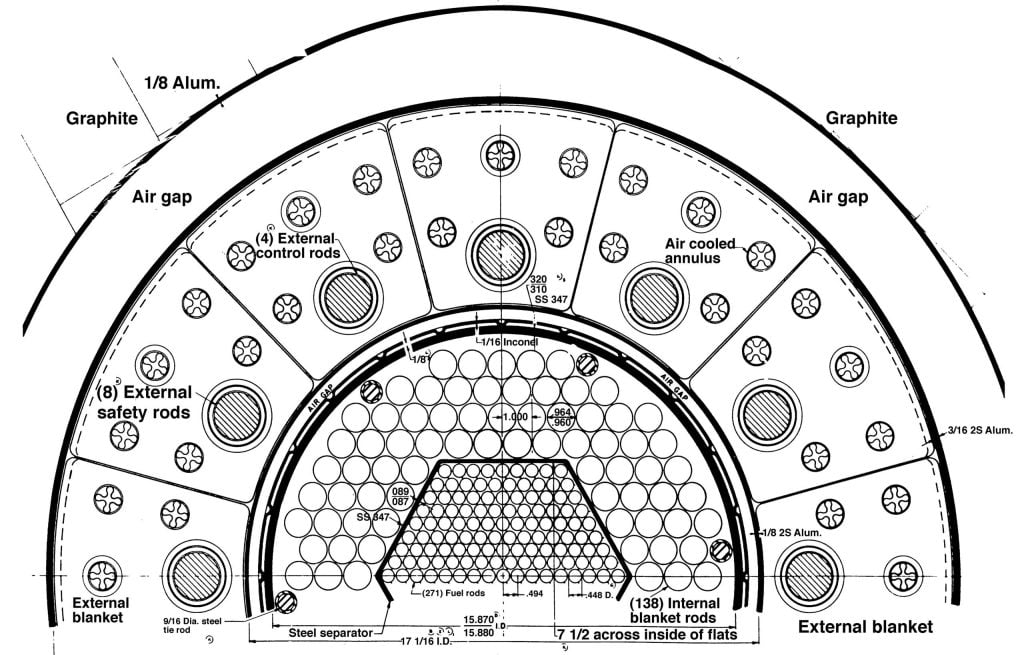
Cross section of a nuclear test reactor.
How do I receive legacy document support?
GAIN engages with the nuclear industry to identify legacy documents and technical information that can be leveraged to accelerate the commercialization of nuclear technologies. Once priority information is identified, GAIN works with DOE national laboratories and other document owners to locate and facilitate access to relevant documents, drawings, datasets, and other technical resources. This process may include locating and scanning hard-copy records, coordinating updated classification and information reviews, and collaborating with document owners to address requirements necessary for release and access.
The available legacy document collection covers a broad range of nuclear technologies and can support industry efforts to leverage historical research, operating experience, and technical knowledge.
Many of the experimental results captured in legacy documents cannot be replicated, because the facilities that generated the original data no longer exist. By leveraging the knowledge of the past, the nuclear industry will shorten development life cycles and decrease costs.